
Openers & grip
Electric Jar Opener Options for Seniors With Arthritis
On this page
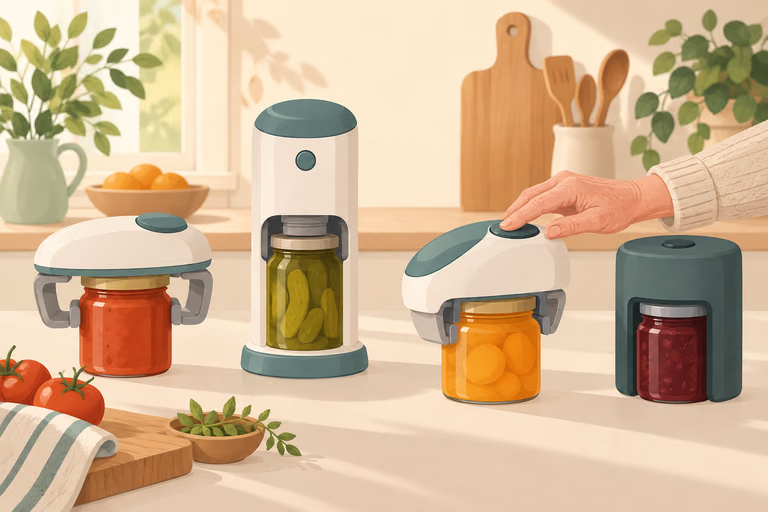
Comparison: What to Check Before ChoosingWhich option fits which situation?Understand the Difference Between the OptionsA Practical Selection ChecklistSources and Editorial BasisWhen loosening a lid while the jar stays on the counter is the hard part, consider a motorized tool placed on the jar — or a mounted manual opener when batteries are unwanted — and our conditional picks below name the documented option for each workflow. Those picks appear under the heading “Which option fits which situation?”, drawn only from manufacturer documentation; a model is left out when its identity stays unverified here.
Start with the task you need help with: positioning the opener, pressing its controls, holding the jar, or twisting the lid. An electric motor does not tell you whether the whole process will be manageable. Check the exact model’s instructions, your usual jar sizes, and the return policy before choosing.
This is a research-based buying guide, not a hands-on test ranking. It does not assign opening-success scores or recommend a model by arthritis severity. The Arthritis Foundation’s self-help device guidance includes jar-opening aids among practical tools for daily activities; it does not establish a winner among the products below.
Affiliate disclosure: As an Amazon Associate we earn from qualifying purchases. The shopping links below may earn us a commission. Search links open results rather than a verified individual product. Check the seller, model, and current price before ordering.
For the wider setup, see the Complete Arthritis Kitchen Guide and our best manual jar gripper for weak hands.
Comparison: What to Check Before Choosing
| Option | Evidence available in this guide | Check before purchase | Shopping link |
|---|---|---|---|
| Hamilton Beach OpenEase | The manufacturer identifies model 76800 but marks it no longer available from its own store | Exact model, power source, instructions, seller, and availability | Search on Amazon |
| EZ Off mounted opener | Zulay Kitchen describes an under-cabinet, manually operated opener | Exact version, mounting requirements, reach, and ability to turn the jar | View Amazon listing |
| Kitchen Mama search | Brand search only; no electric jar-opener model is verified here | Whether the result is a jar opener, can opener, or manual multi-tool | Search on Amazon |
| KITCHENMUH KC12 (White) | No first-party model source is matched in this guide | Manufacturer instructions, jar compatibility, controls, and return terms | View Amazon listing |
| Robo Twist Original (1014) | No first-party model source is matched in this guide | Lid compatibility, placement, and release procedure | View Amazon listing |
The rows are not a quality ranking. Manufacturer information about a product family does not independently verify the item currently sold through an Amazon listing. We omit prices, star ratings, opening times, and battery-life estimates because we do not have the records needed to substantiate them.
Which option fits which situation?
These conditional picks rely only on the manufacturer documentation cited in this guide; they are not test results or a ranking. The model identity of KITCHENMUH KC12 and Robo Twist Original (1014) remains unverified here, so they are not picked.
Best for electric operation with a documented model: Hamilton Beach OpenEase 76800. The manufacturer’s product page documents a battery-powered design with separate opening and release buttons, powered by two AA batteries, placed on top of the jar. The manufacturer marks it no longer available from its own store, so match the model number on the listing and check the third-party seller’s return terms.
Best for a no-battery, mounted option: EZ Off (Zulay Kitchen). The manufacturer documents an under-cabinet manual design that grips the lid while you turn the jar. It needs no batteries and no counter space, but opening still requires reaching the mount and turning the jar — compare that movement with the user’s abilities first.
Best if the task is actually cans, not jars: Kitchen Mama One-To-Go. The manufacturer documents an electric can opener, not a jar opener. If screw-top jars are not part of the task, a documented can opener is the more direct match.
Understand the Difference Between the Options

Hamilton Beach OpenEase: check the model, not just the name
Hamilton Beach’s OpenEase model 76800 page describes a battery-powered device placed on top of a glass jar, with opening and release buttons and two AA batteries. It is not a corded countertop appliance. As checked on September 11, 2026, the manufacturer marks it no longer available from its own store; this does not establish whether a third-party seller has stock. Check the exact model, seller and return terms before buying.
Before ordering, match the model number on the listing to the manual supplied by the seller. Read both the opening and release steps. A description such as “automatic” leaves unanswered how the jar is positioned and how the lid is removed afterward.
EZ Off: a mounted manual alternative
The Zulay Kitchen EZ Off page describes a manually operated tool mounted under a cabinet. Its instructions call for placing the lid in the grip and turning the jar. It should not be counted as an electric opener or a motor-assisted hybrid.
For a mounted option, consider the complete movement: reaching the tool, supporting the jar, turning it, and bringing it back to the counter. Confirm the mounting instructions for the exact item, including the cabinet surface. A mounted design is not automatically suitable for every person who uses one hand.
Kitchen Mama: distinguish cans from jars
Kitchen Mama’s One-To-Go product page describes an electric can opener. That is not evidence of an electric opener for screw-top glass jars. Brand search results can contain different opening tools; read the product type rather than relying on the brand name or a thumbnail.
This guide does not verify a “Kitchen Mama Auto” electric jar-opener model. We therefore do not name it a winner or assign jar-opening performance figures to it.
KITCHENMUH and Robo Twist: confirm the listing details
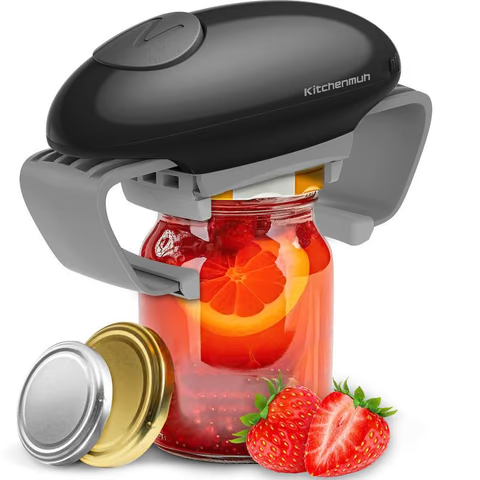
The links in the table are starting points for checking the exact products. We have not matched a first-party product page or manual to KITCHENMUH KC12 or Robo Twist Original (1014), so their model identity remains UNKNOWN in this guide. We have not established comparative opening success, button force, noise, or battery endurance for them. Ask for the instructions if the listing does not clearly show how the opener is placed, activated, stopped, and removed.
If those steps or the model identity remain unclear, keep comparing rather than treating an attractive headline or customer rating as proof that the product will suit your hands.
A Practical Selection Checklist
Controls: Look at the location and action of each button. Does the task require a brief press, a sustained hold, a squeeze, or a twist? Include release and battery-compartment controls in the comparison.
Jar compatibility: Measure the jars you normally use and compare them with the exact manual’s limits. Do not assume a device handles every lid material, shape, or size because it is described as universal.
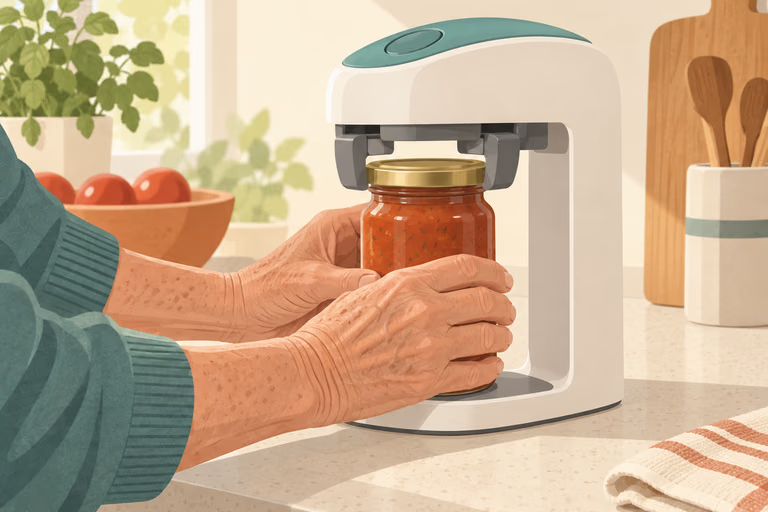
Placement and support: Work through where the jar sits and what your other hand does. Consider a filled jar as well as an empty one. A powered opening action may still leave positioning and lifting tasks to the user.
Power and storage: Check the listed battery type or cord requirements, who will maintain it, and where it will live. Avoid choosing from an unverified estimate of how many jars a set of batteries can open.
Cleaning and release: Read the manufacturer’s cleaning and jam-release instructions before use. Do not assume an electrical device can be immersed or that a stuck mechanism can safely be forced.
Returns: Check the actual seller’s return terms. A useful return policy matters when grip, reach, and control preferences are personal and cannot be judged from product photos alone.
Frequently asked questions
Which electric jar opener is best for arthritic hands?
There is no supported universal winner in this guide. Match a verified model to the steps you find difficult, especially placement, activation, and release. For personal advice about painful or limited movement, ask your clinician or occupational therapist; a product comparison does not replace that assessment.
Is an electric can opener also a jar opener?
Do not assume so. Kitchen Mama’s One-To-Go is described by its manufacturer as a can opener. Check that the exact product and instructions cover the screw-top jars you want to open.
Will an automatic opener handle every vacuum-sealed jar?
We cannot promise that. Check the manufacturer’s limits and instructions for your lid type, and do not rely on success percentages without a documented test method. Stop if the jar or tool is damaged, or if following the instructions requires a movement you cannot manage safely.
Is a mounted manual opener worth considering?
It is a different option to compare, particularly when cabinet installation is practical. The EZ Off instructions still involve turning the jar. Consider reach, support, and turning together rather than assuming that a fixed tool removes every difficult movement.
How long will the batteries last?
This guide has no measured battery-endurance results. Use the exact manufacturer’s instructions for battery requirements, and treat listing estimates as claims to check rather than figures verified by this site.
Sources and Editorial Basis
- Arthritis Foundation: self-help devices, for general context about daily-living aids.
- Hamilton Beach: OpenEase model 76800, for model, controls, battery power and manufacturer-store availability as checked on September 11, 2026; third-party stock remains unverified.
- Zulay Kitchen: EZ Off product and care information, for the mounted manual design.
- Kitchen Mama: One-To-Go electric can opener, for the distinction between can and jar products.
Sources checked September 11, 2026. Product illustrations on this page are not test photographs. Manufacturer descriptions are identified above; they are not independent measurements or proof that a linked retailer listing matches the described version.
Models named in this guide
Catalog-verified identities, checked against the listing on the date shown. Prices and availability change; re-check the listing before buying.
 EZ Off Under-Cabinet Jar OpenerView the listing →
 KITCHENMUH Electric Jar OpenerView the listing →
- no photoRobo Twist Original Electric Jar OpenerView the listing →
More guides for this task
Openers & grip
One-Touch Can Opener Options for Elderly Users
Openers & grip
5-in-1 Kitchen Opener Options for Seniors: What to Check
Openers & grip
Bottle Opener Options for Seniors With Arthritis