
Outage essentials
Easy-Open Water Storage Options for Seniors
On this page
Match the container to the pourManufacturer notesWhich option fits which situation?What public guidance actually saysWho should skip which shapeVerdictStored water is useful only if the person can open, pour, and clean the container. A wide cap, a spigot, a collapsible jug, and a daily pitcher are different jobs — no one container is the right answer for every household.
This page draws on published manufacturer and retailer documentation — no container was filled, lifted, or opened for it, and no opening force was measured. Before buying, re-read the listing for capacity, filled weight, cap type, food-grade marking, and seller terms. Storage does not purify water.
Affiliate disclosure: As an Amazon Associate we earn from qualifying purchases. The shopping links below are searches, not verified individual listings. Search results can mix sizes, bundles, and unrelated jugs. Check manufacturer, model, seller, and price before ordering.
A 72-hour plan covers water, light, food, and contacts — match each layer to what this household can carry and open. For fridge food during an outage, decide in advance what stays and what goes.
Match the container to the pour
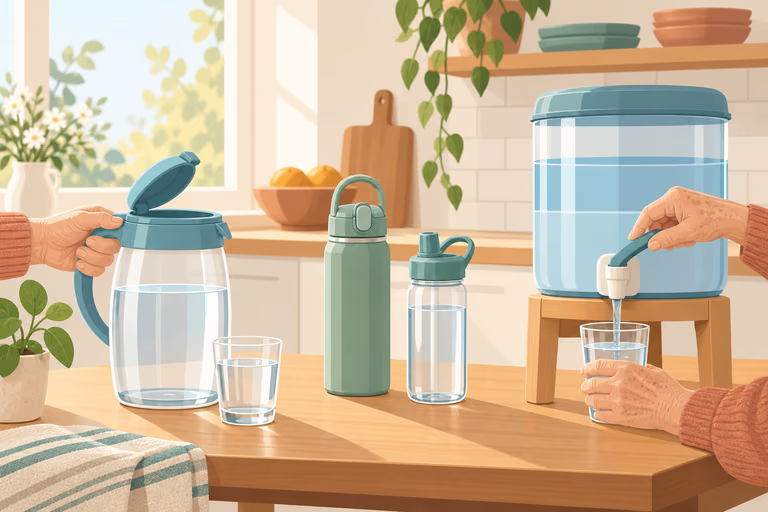
| Option | Job to match | What to verify | Shopping path |
|---|---|---|---|
| Stackable wide-cap brick | Closet storage with a palm-turn cap | Empty vs full weight, stack lock, and whether 3.5 gal is liftable | Search WaterBrick 3.5 gallon |
| Collapsible carrier with spigot | Flat storage empty; tap when full | Dry-fold care, spigot washer, and filled weight | Search Fold-A-Carrier |
| Rigid carrier with spigot | Counter pour with no lifting after fill | Footprint, drip, and that it is filled where it sits | Search Coleman 5-gallon carrier |
| Small sport cooler | Familiar push-button spout, lighter carry | Capacity vs a 3-day plan; water-only use | Search Igloo 2-gallon cooler |
| Daily pitcher | Always-rotated first gallon in the fridge | Lid motion, pour weight, filter cost if any | Search Brita Everyday pitcher |
A gallon of water weighs about 8.3 lb. A 5-gallon fill is about 42 lb plus the jug. If the user cannot lift that, the container must be filled where it will be used.
Manufacturer notes
- WaterBrick (standard size): WaterBrick’s specification page documents the standard container at 3.5 gallons, 9 x 18 x 6 inches, 2.52 lb empty and about 27 lb filled with water, with a 3¼-inch lid diameter on a notched lid with a full gasket. Container, lid, and gasket are BPA-free and FDA compliant.
- Reliance Fold-A-Carrier: Reliance’s product page documents the 5-gallon model as #05010-23, an 11.3-inch cube weighing 0.55 lb empty, with an easy-pour, leak-proof on-off spigot and food-safe, PFAS- and BPA-free construction. The 2.5-gallon model is #02510-23.
- Coleman 5 Gallon Chiller Water Carrier: Coleman’s product page documents the 5-gallon carrier with a faucet that unscrews for easy filling and a molded handle for carrying.
- Igloo Sport 2 Gallon Water Jug (item #00041150): Igloo’s product page lists 2 gallons (8 quarts), an empty weight of 2.18 lb, a recessed and angled push-button spigot, and a wide-mouth opening for filling and cleaning.
- Brita Everyday pitcher (Model No. OB46): Brita’s pitcher FAQ identifies the Everyday Pitcher as Model No. OB46 and documents that Original (Standard) filters should be changed every 40 gallons (about 2 months) and that pitchers are hand-wash only, not dishwasher safe.
Which option fits which situation?
The picks below rest only on the manufacturer documentation cited above — not on tests or rankings — and undocumented containers were left out of them.
- Best for closet volume with a palm-turn cap: WaterBrick standard 3.5-gallon. WaterBrick documents a 3¼-inch notched lid with a full gasket, which addresses the pinch-cap worry raised earlier, and a documented fill weight of about 27 lb per brick — still a two-hand carry, so stack it where it will be used.
- Best for filling in place and pouring without lifting: Reliance Fold-A-Carrier 5-gallon (#05010-23). The manufacturer-documented on-off spigot means the carrier can be filled where it sits and poured by tap, matching the article’s rule that a container too heavy to lift must be filled where it will be used.
- Best for a lighter push-button pour at the counter: Igloo Sport 2 Gallon Water Jug. The documented push-button spigot and 2.18 lb empty weight suit hands that struggle with twist caps, but at 2 gallons it is a counter pour, not a 3-day store — keep it water-only, as the table above advises.
What public guidance actually says
The American Red Cross survival-kit page advises storing at least one gallon of water per person per day for three days. An unopened refrigerator is a separate food-safety clock; do not treat stored water as a substitute for local boil-water notices.
Rotate stored tap water on the interval the household can keep, wash food-grade containers before first fill, and follow the manufacturer guide for sanitizing and temperature. Collapsible carriers should be dry before folding if the manual says so.
Who should skip which shape
- Skip a 5-gallon fill-and-carry jug if shoulders or grip cannot manage ~40 lb.
- Skip a stackable brick if the cap still requires a pinch the user cannot make — verify the current cap diameter on the listing.
- Skip a filter pitcher as the only reserve — typical 10-cup pitchers are a daily layer, not a 72-hour store.
- Skip any container that previously held juice or milk unless the manufacturer says it can be sanitized for drinking water.
Frequently asked questions
How should I choose easy-open water storage?
No container wins every kitchen — each shape trades lift, cap force, and cleaning differently. Choose a wide cap or a spigot if twist force is the problem, and treat filled weight as the real spec.
Can I store tap water for months?
Follow the container manual and local water-authority advice. Storage does not purify water. Recheck boil-water notices independently.
Why are the links searches?
This article has no catalog-verified water-jug ASIN. Search links keep model, size, seller, price, and availability unverified.
Verdict
Use a wide-cap stackable jug for closet volume, a spigot carrier filled in place for daily glasses, and a fridge pitcher so one gallon is always rotated. Recheck filled weight and the current listing before buying.
More guides for this task
Outage essentials
Easy Flashlights for Seniors During Power Outages: Options Compared
Outage essentials
Emergency Gifts for Older Homeowners: Kit Layers