
Gifts & safety
Large-Button Kitchen Timers: Digits, Volume, Power
On this page
What to check before you buyTimer types at a glanceWhere the timer livesA loud beep is not supervisionSourcesA large-button kitchen timer is the right purchase only when three checks pass: the digits are readable from where you actually stand while cooking, the alarm reaches you from another room, and the power source fits how the counter is used day to day. If any of those three fails, a more expensive timer will not fix the problem. USFA cooking-fire guidance still says do not leave cooking unattended, so a loud alarm is a backup layer, never a babysitter.
No timer reviewed here was timed, dropped, or beep-checked in a real kitchen; the guide works from manufacturer and retailer documentation instead. Before you buy, verify the model on the current listing and read the seller’s return terms. This is shopping research, not medical advice.
Affiliate disclosure: As an Amazon Associate we earn from qualifying purchases. Direct
dplinks are catalog-verified identities only. Search links can mix variants. Check manufacturer, model, seller and price.
What to check before you buy
Work through four questions in order.
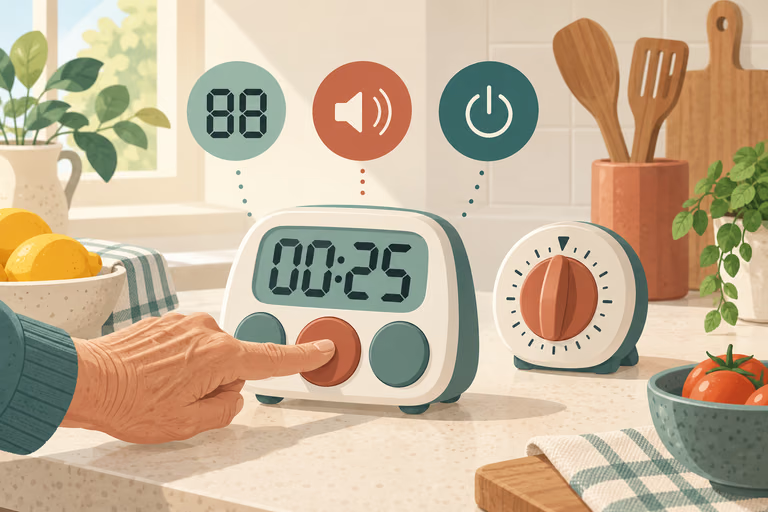
Digits. Readability is a distance question, not a label question. Stand where you actually stand — often two or three steps from the stove — and ask whether you could read the display from there while a pot is steaming. A timer that needs to be picked up and brought close defeats its own purpose. Large LCD digits and strong display contrast matter more than extra features.
Alarm. Manufacturers describe volume in different ways, and “extra loud” is marketing language until you check what the maker actually claims. Read the manufacturer page or the listing for any stated loudness figure, and think about your own home: hallway between kitchen and living room, closed doors, hearing aids that come out at night. A timer that cannot be heard from the next room fails the job it was bought for.
Buttons. Large physical buttons with obvious up/down and start/stop beat touch panels and menu trees. Ask whether the countdown can be set with cold, slightly stiff hands and without reading glasses. Compare large-button models on three points: an up/down pair you can find by touch, a start/stop button that needs no menu, and a face designed for one job rather than several modes (Search on Amazon); search results mix variants of a product family, so identity must be confirmed on the listing you land on.
Power. Replaceable batteries mean a timer that stops the week the battery dies unless someone replaces it. Plug-in or rechargeable designs remove that chore but tie the timer to one spot. Match the choice to who actually changes batteries in this kitchen.
Compare the current field here: Search on Amazon.
Timer types at a glance
| Type | Best fit | Trade-off |
|---|---|---|
| Large digital countdown | One dish, one countdown, weak eyesight | Multi-mode models bury the basic function in menus |
| Analog dial | One-hand operation, no menus at all | Printed numbers are usually smaller; alarm is often softer |
| Multi-countdown digital | Cooking several dishes at once | Smallest buttons of the group; easy to mute by mistake |
| Plug-in countdown outlet | Kitchens where batteries always die | Fixed location; takes over a wall outlet |
No single timer type comes out ahead for every kitchen. The right question is which failure hurts most in this kitchen: reading, hearing, pressing, or battery upkeep.
Where the timer lives
Placement is half the value. A timer on a magnetic back should sit on the range hood or a metal splash guard at eye level, not flat on the counter behind a kettle. If it sits on a stand, the spot must be away from steam and splatter but inside the natural glance line while stirring. The most reliable habit is boring: the timer lives in one place, always, and everyone in the household knows where that is. A timer that migrates through drawers is a timer that will be silent when it matters.
Caregivers can add a second habit: the person cooking keeps one timer near them and a second countdown runs where the caregiver spends time, so two people hear the same deadline.
A loud beep is not supervision
Skip the louder-beep purchase entirely if the real problem is cognition — a person who already loses track of burners or walks away from the stove and does not return. That is a staffing, routine, and clinical-care question, not a volume question. Work the household side with three questions: who watches the stove, how often the burners get checked, and when someone returns to the kitchen. For hands, joints, or endurance limits, weigh button size, the grip needed to set a countdown, and whether the alarm reaches the room where the person spends time.
Frequently asked questions
Can I leave the oven if the timer is loud?
No. USFA guidance is to stay with cooking and use the timer as a reminder layer. A beep cannot remove a burning pan.
Analog or digital?
A large dial avoids menus and suits one simple countdown. Digital usually offers a bigger display and a stronger alarm. Match the choice to vision and hearing, in that order.
How loud is loud enough?
There is no single decibel level that suits every home. Check what the manufacturer states, then judge your own layout — distance, doors, and hearing changes. If a timer cannot be heard from the room where you actually spend time, it is the wrong timer.
Is a phone timer a substitute?
A phone works until its screen is across the room, locked, or silenced by a call. A dedicated timer has one job and one loud speaker. Some households use both.
Sources
More guides for this task
Gifts & safety
Oven Mitts for Weak Grip: Cuff, Length, Heat Rating
Gifts & safety
Birthday Kitchen Gift Options for Seniors With Arthritis
Gifts & safety
Christmas Kitchen Gift Options for Elderly Parents