
Gifts & safety
Oven Mitts for Weak Grip: Cuff, Length, Heat Rating
On this page
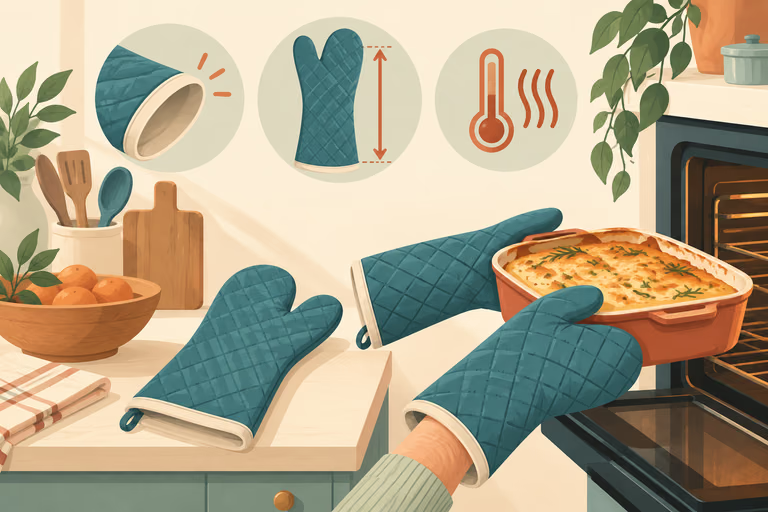
What actually fails when grip is weakHow to compare mitt listingsSilicone or quilted cloth: two different jobsThe kitchen around the mittWhen grip is the symptom, not the problemSourcesAn oven mitt only helps a weak grip when two things are true: the hand can get into it without a fight, and the cuff actually covers the wrist. Everything else — silicone or cloth, color, brand — is secondary. So compare mitts by cuff opening, length past the wrist, grip surface, and the heat rating printed on the listing, which is a manufacturer claim, not an independent result. The U.S. Fire Administration’s cooking-fire page makes the point that no mitt changes: stay with cooking, and keep towels and packaging away from the burners.
Every mitt discussed here is judged on published listing specs, care instructions, and heat-rating claims — none was pulled on, loaded with a hot tray, or scored. Verify the cuff, length, and rating on the current listing and review the seller’s return terms before buying. This is shopping research, not medical advice.
Affiliate disclosure: As an Amazon Associate we earn from qualifying purchases. Direct
dplinks are catalog-verified identities only. Search links can mix variants. Check manufacturer, model, seller and price.
What actually fails when grip is weak
A mitt that works for strong hands can fail a weak grip in four specific ways, and each one is visible in the listing before buying:
- The cuff does not open. A narrow, floppy cuff turns putting on a mitt into a two-hand, one-minute struggle. Look for photos that show a wide or structured cuff opening.
- The mitt is too long or heavy to manage. Extra length protects the forearm, but a stiff long mitt can be hard to pull on and off. Length past the wrist is the goal; the effort of getting it on is the trade.
- The padding is stiff when new. Thick quilted mitts usually loosen after washing. A brand-stiff mitt may need breaking in — exactly the period when a weak grip gives up on it.
- The surface behaves differently when wet or greasy. A silicone shell grips a dry pan; a wet one behaves differently. The care instructions say what the maker expects.
None of these is a defect. They are fit questions, and listing photos plus care instructions answer most of them.
How to compare mitt listings
| Check | Why it matters for weak grip | Where to confirm it |
|---|---|---|
| Cuff opening width | The hand has to enter without a second person helping | Listing photos and video |
| Length past the wrist | Wrist and lower-forearm skin is where steam burns happen | Measured specs on the listing |
| Weight when new | A heavy mitt is a mitt that stays on the hook | Listed weight or product specs |
| Inner liner | Smooth liners slide; terry liners add friction but dry slowly | Listing description, care label |
| Heat rating | It is the maker’s claim about contact heat, not a guarantee | Manufacturer page, not a review |
| Washing method | A mitt that cannot be machine-washed often stops being used | Care instructions |
If a listing hides one of these rows, treat that as information too. A seller who will not print the cuff opening may have a reason.
Two starting searches, each a different tradeoff: Search on Amazon for wipe-clean shells, and Search on Amazon for longer cuffs. A search page can mix variants, so re-check every row of the table on the actual listing.
Silicone or quilted cloth: two different jobs
Silicone wipes clean and shrugs off the steam that escapes a pot lid, but it is usually stiffer than cloth of the same size. Quilted cloth flexes and weighs less, but it soaks through faster when damp and stains with use. Neither one is burn-proof, and neither rating means a hand can hold a hot pan indefinitely.
If the cooking is mostly oven trays and covered pots, the wipe-clean shell may fit. If the cooking is quick stovetop work with many small grabs, the lighter cloth may fit. The honest answer is that many households end up with one of each hanging by the stove, because baking and pan work are different jobs. Pocket-type handle holders are a different shape again — they stay on the pan, which solves the donning problem and creates a hot-pan-on-the-counter problem instead.
The kitchen around the mitt
The mitt is one part of a lift that also includes the pan. A two-handle pot changes where the weight sits, but it does not change what a mitt can do — both handles still get hot, and the cookware manual, not the mitt listing, says what the handles tolerate. See two-handle pots for seniors and the wider lightweight cookware guide for that half of the equation.
A folded mitt used as a trivet is also a different risk than a mitt on a hand; a proper trivet or a dry towel on a safe surface does that job. And when cognition, not grip, is what makes heat unsafe, no mitt fixes it. The fix is supervision and staying with the cooking — which is what the USFA page has said all along.
When grip is the symptom, not the problem
Arthritis changes how hands plan a movement, not only how strong they are. The Arthritis Foundation’s joint-protection tips describe spreading load across joints and using the larger, stronger joints — the same logic behind a mitt that opens wide and does not demand a pinch to don. But pain that is new, worsening, or changing how someone cooks is a conversation for a clinician or occupational therapist, who can assess the actual hand and the actual kitchen. A mitt buying guide cannot do that, and this one does not try. The arthritis kitchen tools hub organizes the rest of the tool decisions the same way: by the task that hurts, not by product names.
Frequently asked questions
Is silicone safer than cloth?
Silicone wipes easier and handles steam; cloth flexes and weighs less. Neither is burn-proof, and a heat rating on either is a manufacturer claim about contact, not permission to hold a hot pan. Match the material to the cooking, then confirm the care instructions.
Skip mitts with a two-handle pot?
No. Handles still get hot. A two-handle pot changes the lift, not the glove physics. Check the cookware manual for what the handles tolerate, and follow the USFA cooking-fire guidance to stay with the stove.
How long should the cuff be?
Long enough that the wrist bone and the bit of forearm below it are covered when the arm reaches into the oven. The exact measurement lives on the listing’s spec line, not in a rule of thumb — and a cuff that cannot be pulled on defeats the length.
Are heat ratings independently verified?
No. The rating is the manufacturer’s description of contact heat under conditions the maker defines. Treat it as a claim to compare between listings, and treat “flame resistant” as a different sentence from “heat proof.”
Sources
Related reading: Two-handle pots · Lightweight cookware · Arthritis kitchen tools hub
More guides for this task
Gifts & safety
Gift Bundle vs Single Tool: When Mixing SKUs Fails
Gifts & safety
Kitchen Gift Options for Seniors With Arthritis
Gifts & safety
Large-Button Kitchen Timers: Digits, Volume, Power