Cookware
Non-Slip Mixing Bowls: Base, Weight, Cleaning
On this page
What actually keeps a bowl stillHandles, pour spouts, and the filled weightMaterial: stainless, plastic, glass, or ceramicBuying checks that are not scoresSourcesA mixing bowl fails when it spins while you stir or when the full bowl is too heavy to pour. So the right bowl is decided by two things before brand or color: whether the base stays put on a wet counter, and whether you can lift and tilt the bowl filled. A silicone or rubber base ring is one tactic for the first problem. Batch size, handles, and a pour spout are tactics for the second. Joint-protection tips from the Arthritis Foundation describe stabilizing work and using larger joints — a bowl is one place to apply them. A silicone ring is a kitchen convenience, not a medical device, and it does not strengthen a grip.
The bowls discussed here were never filled, stirred, or lifted in a test kitchen; what follows is a read-through of manufacturer and retailer documentation, organized into the checks that matter for a wobbly or heavy bowl. Re-check the listing, model, and return window before you buy, and treat this page as shopping research — for hand strength or pain, speak with a clinician or occupational therapist.
Affiliate disclosure: As an Amazon Associate we earn from qualifying purchases. Direct
dplinks are catalog-verified identities only. Search links can mix variants. Check manufacturer, model, seller and price.
What actually keeps a bowl still
Retail listings sell “non-slip” as one word, but there are three different mechanisms behind it:
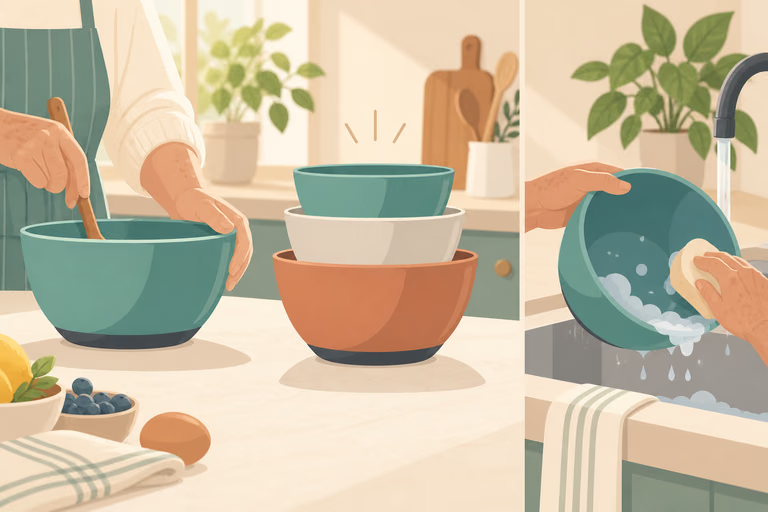
- A base ring or pad — silicone or rubber on the bottom. This is the most common design. It grips a dry counter well and is weaker on a wet one, which is exactly when you are rinsing batter off the counter. Wipe the counter before you start; the ring is not a substitute for that.
- Weight itself. A heavy stoneware or thick glass bowl does not walk because mass resists the push of a whisk. The trade-off is obvious: the same mass works against you at the sink.
- Shape. A wide, flat-bottomed bowl is steadier than a small rounded one. A narrow tall bowl tips more easily when you scrape the sides.
Check which mechanism a listing actually describes. “Non-slip” in a title with no base material named is a keyword, not a spec.
Handles, pour spouts, and the filled weight
A silicone base fixes spinning. It does nothing about lifting a gallon of batter to the counter edge or tilting it into a pan. That job belongs to the rest of the design:
- A single handle lets you steady the bowl with the same hand that pours. A two-handle bowl splits the job between hands, which matters when one hand is weaker. Neither replaces the two-handle pot when the mixing is happening on the stove.
- A pour spout turns “tip and hope” into a controlled pour. It also means you can rest the bowl’s edge on the pan rim while pouring, so the arm carries less weight.
- Batch size beats bowl size. If a full bowl is too heavy to move, the honest fix is mixing smaller batches, not hunting for the one bowl that is magically light full. Splitting pancake batter into two small bowls is less work than dragging a big one.
The filled weight is the number that decides all of this, and it is rarely printed anywhere. Estimate it yourself: a quart of thin batter is roughly two pounds, plus the bowl’s own empty weight, which usually is listed. If a full batch would be more than you lift comfortably from the sink, choose a smaller bowl or smaller batches.
Material: stainless, plastic, glass, or ceramic
| Material | Stays put when stirred | Empty weight to lift | Cleaning | Watch out for |
|---|---|---|---|---|
| Stainless with silicone base | Good on dry counters; wipe the counter when wet | Light for its size | Usually dishwasher-safe | Thin walls can dent; base ring can wear |
| Plastic with rubber base | Good; lightest full-bowl lift | Very light | Dishwasher-safe on most listings | Can stain and hold odors; check BPA-free labeling |
| Glass | Heavy enough not to walk, but heavy to pour | Heaviest | Dishwasher-safe | Drop and thermal-shock risk; not for weak grip |
| Ceramic/stoneware | Very stable on the counter | Heaviest | Often dishwasher-safe | Chips; weight when full is the limiting factor |
One note on dishwasher care: a silicone base ring can trap water and detergent residue. If the listing does not say the bowl is dishwasher-safe, assume hand washing — and check whether you can physically hold the bowl under a tap when it is full of suds.
Buying checks that are not scores
Before any purchase, run this list against the actual listing page:
- Base material named? Silicone or rubber ring, stated in the spec table, not just the title.
- Empty weight listed? You need it to estimate filled weight.
- Dishwasher-safe stated? For the bowl and the base, if they differ.
- Handle shape described? Photos hide whether a handle fits swollen or braced knuckles.
- Return terms. A bowl that seemed fine on screen may be wrong in the hand.
If a listing does not answer these, search wider rather than guessing: non-slip mixing bowl search on Amazon and bowl-with-handle search on Amazon. More background on choosing adaptive tools is in the complete arthritis kitchen guide.
Frequently asked questions
Does a non-slip base replace a weak grip?
No. It stops the bowl walking while you stir. It does not lighten a gallon of batter or help you tilt a heavy bowl to pour. Batch size, handles, and a spout do that work.
Stainless or plastic for arthritic hands?
Plastic is lighter both empty and full, which matters most if lifting is the limit. Stainless cleans up without holding stains or smells. Neither choice is a clinical recommendation — pick by the job that fails first for you.
Are glass mixing bowls safer because they are heavy?
Heavier means more stable on the counter and harder to move by accident, but also harder to lift, pour, and wash. For many older adults the weight is the problem, not the solution. Glass also breaks, and cleanup after a break is a real risk.
What size bowl should I buy?
Buy for the batch you actually mix, not the largest recipe you own. If you regularly make large batches, two small bowls beat one large one you cannot pour.
Do I need a stand mixer instead?
That is a different tool with its own weight, setup, and cleaning demands. If hand mixing hurts, it is worth discussing with an occupational therapist, who can also suggest technique changes before any purchase.
Sources
Related reading: Two-handle pots · How to chop · Complete arthritis kitchen guide