Cookware
Two-Handle Pot Options for Seniors: What to Compare
On this page
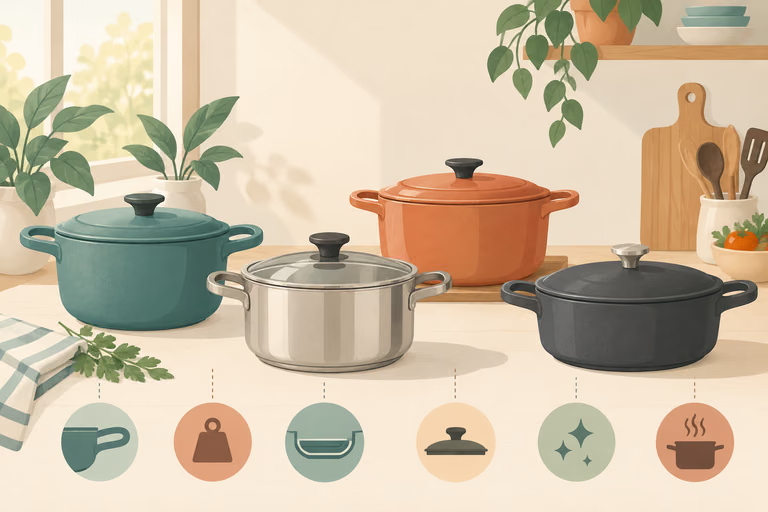
What to verify before comparingQuick comparisonWhich option fits which situation?Manufacturer notesWhy handle fit mattersHow to chooseVerdictSourcesWhen soup must travel from stove to sink, consider a two-handle pot whose documented net weight and handle spacing fit the grip — a matched stainless body with its lid, a tri-ply sauce pot, or a light nonstick stock pot — and our conditional picks below name the documented option for each route. Those picks appear under the heading “Which option fits which situation?”, based only on the manufacturer pages cited here; a pot without a cited specification is not picked.
For a two-handle pot, check whether you can reach and grip both handles with your usual oven mitts, then compare the pot’s filled load, lid and route from stove to sink. Two handles alone do not make a heavy pot manageable. This is a documentation-based guide, not a hands-on test or clinical assessment.
Disclosure: This guide contains affiliate search links. If you buy through a link, we may earn a commission at no extra cost to you. Model configuration, availability and prices can change. Confirm the exact size, SKU and manufacturer instructions before ordering. This article is informational only and is not medical advice.
What to verify before comparing
The practical load is the empty pot, lid and the food or liquid you plan to carry together. Read the manufacturer’s net weight and capacity for the exact model, then decide whether filling and draining can happen at the stove. If the route or grip is uncertain, use a ladle or draining insert instead of carrying a full vessel.
Check these fields for every candidate:
- exact model or SKU, capacity and net weight;
- handle spacing, clearance and grip surface with the user’s mitts;
- lid weight, lid handle and steam direction;
- material, nonstick care and allowed utensils;
- induction and oven compatibility for the exact pot, lid and handles;
- warranty, recall notices and current availability.
Quick comparison
| Product to investigate | Research focus | Search |
|---|---|---|
| T-fal Bistro 5-Qt | Confirm empty weight, two-handle geometry, lid, coating care and exact cooktop limits. | Search on Amazon |
| Farberware Classic 8-Qt | Confirm the exact stainless model, handle construction, lid and net weight. | Search on Amazon |
| Tramontina Tri-Ply Clad 6-Qt | Confirm tri-ply model, handles, cooktop compatibility, oven limit and lid. | Search on Amazon |
| IMUSA 6.6-Qt Caldero | Confirm net weight, side handles, lid, material and heat instructions. | Search on Amazon |
| Granitestone 5-Qt | Confirm the exact SKU, helper handles, lid, coating care and cooktop limit. | Search on Amazon |
These are search starting points, not ranked winners. Marketplace results can mix sizes and revisions, so match the product name and model number with the manufacturer’s page.
Which option fits which situation?
The suggestions below rest solely on the manufacturer pages referenced in this article’s notes and sources; they are not the outcome of our own cooking trials or an ordered comparison. T-fal Bistro and IMUSA Caldero have no model-specific specification cited here, so neither is suggested.
Best for a documented stainless construction with a matched lid: Farberware Classic 8-Quart Stainless Stockpot with Phenolic Handles. Farberware’s official product page lists construction, handle, lid, cooktop and oven details specific to the size it displays, so confirm the listing shows the same Classic line before ordering. The brand’s nonstick two-handle stockpots carry different care and induction information, so do not mix the two lines.
Best for tri-ply stainless with a stated oven limit: Tramontina Signature 6-Quart Tri-Ply Clad Covered Sauce Pot. Tramontina’s page identifies the tri-ply clad construction, compatible cooktops, lid and oven limit for that SKU. Those limits apply to that SKU only, so verify them again if a listing shows a different Tramontina 6-quart pot.
Best for a low-maintenance nonstick routine: Granitestone 5 Quart Aluminum Stock Pot (SKU 7503). Granitestone’s page identifies SKU 7503 and describes a nonstick stock pot with lid that is dishwasher-, oven- and metal-utensil-safe. That description covers this SKU alone; match the SKU on the listing before comparing it with other Granitestone colors or sizes.
Manufacturer notes
T-fal Bistro 5-Quart
T-fal’s care and use guidance says that directions vary by product type and recommends checking the supplied instructions for utensil, heat, oven and cleaning use. Confirm the exact Bistro model before applying any feature to the Amazon result.
Farberware Classic 8-Quart
Farberware’s official Classic stainless stockpot page lists product-specific construction, handles, lid, cooktop and oven details for its displayed size. The same brand also sells nonstick two-handle stockpots with different care and induction information, so do not transfer specifications between lines.
Tramontina Tri-Ply Clad 6-Quart
The official Tramontina 6-Quart Tri-Ply Clad Sauce Pot page identifies the construction, compatible cooktops, lid and oven limit for that SKU. It is a primary source for that product page, not proof that every 6-quart Tramontina pot has the same specification.
IMUSA 6.6-Quart Caldero
No model-specific manufacturer source is used here. Confirm the current IMUSA product page or manual for net weight, handle attachment, lid, cooktop and cleaning instructions. Do not infer a safe lifting load from the word “lightweight” or from the material name.
Granitestone 5-Quart
The official Granitestone 5 Quart Aluminum Stock Pot page identifies SKU 7503 and describes a nonstick stock pot with lid as dishwasher-, oven- and metal-utensil-safe. It is not evidence for another Granitestone color, size or product line; match the SKU before comparing.
Why handle fit matters
The Arthritis Foundation’s joint-protection tips recommend using larger joints and muscles for heavy loads, keeping objects close and sliding them instead of lifting when possible. Use that as general context, not as a clinical endorsement of any pot. The user still needs a handle they can reach and grip without pinching or twisting.
The U.S. Fire Administration’s cooking guidance says to stay by the pan, turn burners off when leaving and turn pot handles toward the back of the stove. These habits do not make a full pot safe to carry. Keep the route short and use a utensil or another person when needed.
How to choose
Plan the filled load
Compare the manufacturer’s empty weight with the planned food or liquid. Fill at the stove when possible and avoid moving a full pot of boiling liquid to the sink. Capacity is not a lifting recommendation.
Check the grip before buying
Before buying, compare handle spacing, shape and clearance with the user’s normal mitts. A helper handle that is too close to a hot wall or too small for the user’s hand may be unusable. Manufacturer pictures cannot replace checking the exact listing and, when possible, handling the pot in person.
Match surface and cleaning routine
Nonstick surfaces require the care and utensil limits in their product manual. Stainless surfaces may suit higher-heat cooking but can require a different cleaning routine. Choose the routine the user can perform comfortably.
Verify cooktop and oven details
Check the exact induction symbol, oven limit and lid/handle restrictions. Tramontina’s product collection explains that these limits vary by construction and components. Never carry a pot from the listing’s marketing copy into a different model.
Use a lid carefully
Lift a hot lid away from the face and leave a clear counter space before setting it down. A lid that is difficult to grip can change the overall handling decision even when the pot itself feels manageable.
Frequently asked questions
Is a two-handle pot safer than a single-handle pot?
It may allow a balanced two-handed grip for some users, but it is not a safety guarantee. The handle size, distance, lid and filled load must work for the individual. If any part of the lift is uncertain, do not carry the full pot.
What capacity should one person choose?
Choose the capacity that matches the recipes and the amount the user can fill, move and drain comfortably. A smaller vessel can be easier to control; a larger one may be useful when it is filled and drained at the stove. Do not choose by household size alone.
Is nonstick or stainless better for arthritis?
There is no universal material choice. Compare cleaning effort, heat limits, utensil rules and the user’s grip. Follow the product manual and replace cookware if the surface or handle is damaged.
Can I carry a full stockpot to the sink?
Avoid carrying a full pot of boiling liquid when a ladle, strainer or staged drain is available. Keep both hands on the handles only when the user can control the load and route, and ask for help if balance or pain is a concern.
What should I confirm before checkout?
Match the product name, size, model number, net weight, handle arrangement, lid and cooktop/oven limits between the manufacturer page and marketplace listing. Recheck availability and current terms at checkout.
Verdict
There is no evidence here for one universal best two-handle pot. Choose the exact model whose handle fit, filled-carry plan, lid, cooking surface and care instructions match the person using it. The Amazon links help locate candidates; the manufacturer’s current manual should make the final specification decision.
Continue with the ergonomic kitchen knife guide and the complete arthritis kitchen guide. You can also search Amazon for lightweight two-handle stockpots after identifying the model you want to verify.
Sources
- T-fal Care and Use
- Farberware Classic Stainless Stockpot
- Tramontina 6-Quart Tri-Ply Clad Sauce Pot
- Granitestone 5 Quart Aluminum Stock Pot
- Arthritis Foundation: Joint Protection
- U.S. Fire Administration: Cooking Fire Safety