
Outage essentials
Lightweight Lanterns for Stiff Hands: Switch and Batteries
On this page
What stiff hands actually need in a lanternLantern, plug-in, or flashlight: match the light to the roomThe three checks before you buyCharging and storage before storm seasonSourcesFor a stiff or arthritic grip, the best lightweight lantern is the one you can switch on, carry, and refuel in the dark without a pinch grip, a twist cap, or a tiny recessed button. USFA prefers flashlights and battery lights to candles during an outage. Stiff hands fail on battery doors and small sliding switches far more often than they fail on lumen marketing, so this guide compares lanterns by the motions your hands must perform, not by brightness numbers alone.
This page is built from lantern listings, manuals, and outage-safety guidance rather than a night spent testing lights in a blackout — no unit here was switched on, weighed, or ranked. Verify the model, switch, and battery door on the current listing and check the seller’s return terms before buying. Nothing here is medical advice.
Affiliate disclosure: As an Amazon Associate we earn from qualifying purchases. Direct
dplinks are catalog-verified identities only. Search links can mix variants. Check manufacturer, model, seller and price.
Vont LED lantern two-pack View Amazon listing — switch, battery access, two units. Path lighting: Energizer Auto-On View Amazon listing if an outlet is on the route. Carry beam: Search on Amazon.
Runtime claims are manufacturer numbers. Charge before storm season. Skip any lantern whose battery door they cannot open.
What stiff hands actually need in a lantern
Four physical details decide whether a lantern gets used during a real outage:
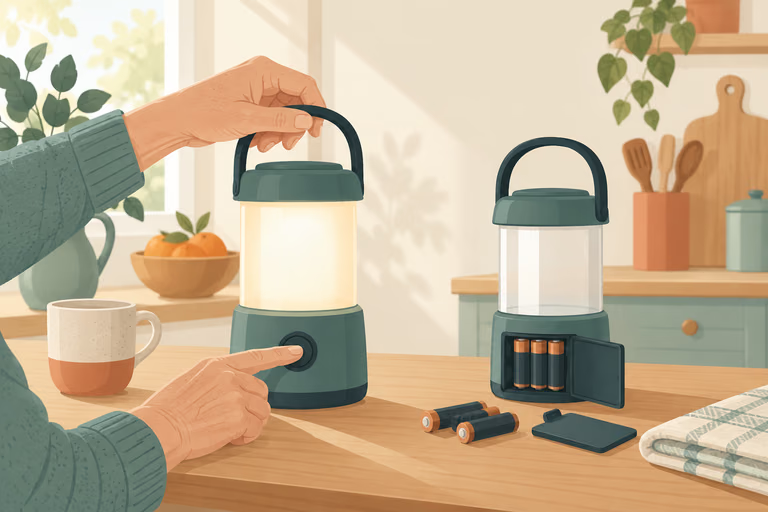
- A switch the whole finger can press. A large rubber push button or a wide slider beats a small recessed clicker. Look at the listing photo for switch size before anything else.
- A battery door that opens without a coin or a hard twist. Slide locks and hinged latches are easier on stiff thumbs than screw caps. If the listing photos do not show the door, check the manufacturer page or the manual before buying.
- A weight that the filled figure describes. Manufacturers print weight with and without batteries in different places, and D cells change everything. Read the filled weight, not the empty one.
- A shape that sits still. A flat or wide base matters more at a kitchen table than a hanging hook. A lantern that tips over is a candle hazard with extra steps.
None of these are performance scores. They are motions. A lantern that fails one of them stays in the closet during the exact night it was bought for.
Lantern, plug-in, or flashlight: match the light to the room
| Your situation | Best fit | Why |
|---|---|---|
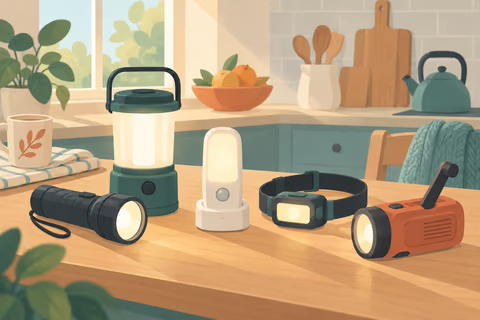
| Dark room, no free outlet | Battery lantern, two units | Area light you can set on a table and move later |
| Hallway or bathroom with an outlet | Plug-in auto-on light | Lights by itself; no switch to find in the dark |
| Walking to another room or the door | Small flashlight | Points where you look and leaves a hand for the rail |
| Long outage with table tasks | Lantern plus fresh spare batteries | Area light and runtime beat reach |
| A fixed night path to the kitchen | Auto-on at that outlet, lantern as backup | The path is always the same |
The two categories are not rivals. The strongest setup is one auto-on light on the night route and one lantern for the room where everyone gathers. When pairing the two, check where the outlet sits along the night route, how long the batteries must hold, and what the lantern weighs once it is filled.
The three checks before you buy
- Switch motion. Can this be pressed with a knuckle while the same hand holds the lantern? If the answer needs two hands and a fingernail, keep looking.
- Battery access. Can the door be opened on a table, without a coin, gripping only with the palm? Check the manual if the photos hide the latch.
- Carry and placement. Does the handle fit the whole hand, and does the base sit flat where it will actually be used?
Also confirm the battery type before storm season starts. A lantern that needs a button-cell size you do not stock is a paperweight in week two of an outage. Keep spare batteries in the same drawer as the lantern — Ready.gov’s power-outage guidance treats flashlights and extra batteries as basic kit items, and co-locating them is what makes the kit real.
Charging and storage before storm season
- Charge rechargeable lanterns fully before the season, then top them up monthly. A lantern found at half charge in September was last charged in June.
- Store the lantern where it can be reached without a step stool. A high shelf defeats the purpose.
- One lantern per floor beats one perfect lantern downstairs.
- If the model has a low-power mode, learn how to reach it now, in daylight, with the manual open.
Frequently asked questions
Lantern or plug-in auto-on?
Lantern for a room without a spare outlet. Auto-on for a hallway you already use. Many homes want one of each.
How many lumens?
Enough to see the floor without glare. Listing lumens are manufacturer claims, not a lab result from this site, and a lower-output light on a low setting often reads better at night than a bright one.
How can I check the battery door before buying?
Look for listing photos that show the door open or half open, and read the manufacturer’s manual page. If neither shows the latch type, treat the door as unknown and weigh that at the return window.
Is it safe to leave a lantern on overnight?
That is a question for the manufacturer’s instructions and, for fire-safety planning, USFA’s guidance, which favors battery lights over open flame. Follow the manual’s runtime notes for the exact model.
Sources
Related reading: Easy flashlights
Models named in this guide
Catalog-verified identities, checked against the listing on the date shown. Prices and availability change; re-check the listing before buying.
- no photoVont LED Camping LanternView the listing →
- no photoEnergizer Auto-On Rechargeable LED FlashlightsView the listing →
More guides for this task
Outage essentials
Easy Flashlights for Seniors During Power Outages: Options Compared
Outage essentials
Easy-Open Water Storage Options for Seniors
Outage essentials
Emergency Gifts for Older Homeowners: Kit Layers