Openers & grip
How to Open Jars With Arthritic Hands: A Safe Order
On this page
Order of operations (no volunteer scores)Why the order mattersChoosing between the tool familiesWhat this page will not doSourcesA vacuum-sealed lid fights pinch and twist, so the safe order for opening one with arthritic hands is: stabilize the jar first, then reduce the grip demand, then let a documented tool do the twisting — in that sequence, stopping at the first step that works. Skipping ahead to brute force is where lids win and hands pay. The Arthritis Foundation’s self-help devices page lists jar openers and built-up handles among practical aids. That is general self-care language. It is not a diagnosis, a pain guarantee, or a product endorsement.
This page orders mechanical steps. Stop if you feel sharp pain, numbness, or loss of control, and ask a clinician or occupational therapist about your hands. NIAMS: Living with arthritis likewise points people to a treatment plan with a doctor; it does not name a kitchen gadget. CDC arthritis basics is the third public reference for what arthritis is — none of these pages endorse a tool on this site.
Affiliate disclosure: As an Amazon Associate we earn from qualifying purchases. Direct
dplinks are catalog-verified identities only. Search links can mix variants. Check manufacturer, model, seller and price.
Order of operations (no volunteer scores)
- Stabilize the jar. A sliding jar makes you pinch harder. A damp cloth, a non-slip pad, or a second person holding the body of the jar is the first job. The manual jar-gripper guide compares pads and base-pad openers for this step.
- Break the vacuum only if the food maker allows it. Running hot water on a lid, tapping the rim, or prying the lid lip can damage some packaging or splash hot liquid. Read the food jar’s label. This site does not clock “seconds under the tap.”
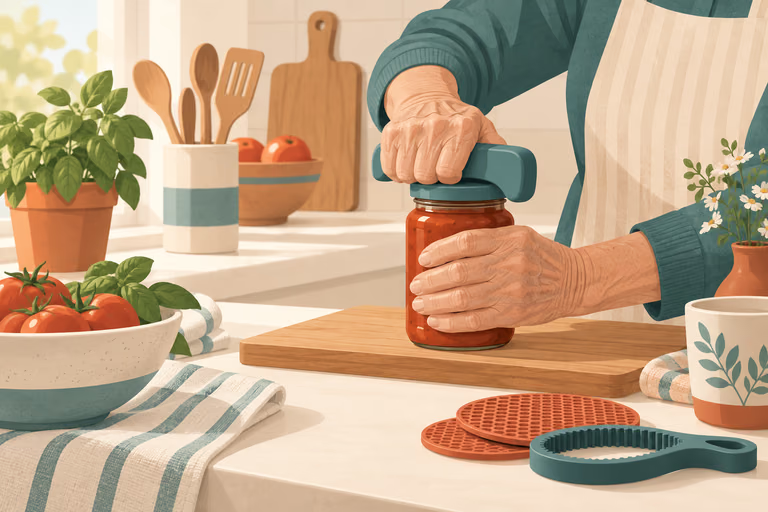
- Add friction or leverage, not thumbnail pry. A silicone pad, a lever opener, or a base-pad tool (catalog identity: OXO Good Grips jar opener with pad, which OXO lists under SKU
1173600) changes the grip. Make sure the listing you reach is that exact SKU rather than a generic “OXO” search hit. - Mounted opener if the jar can be lifted to it. An EZ Off under-cabinet opener only helps if the user can raise the jar and the cabinet can take the mount. See under-cabinet options.
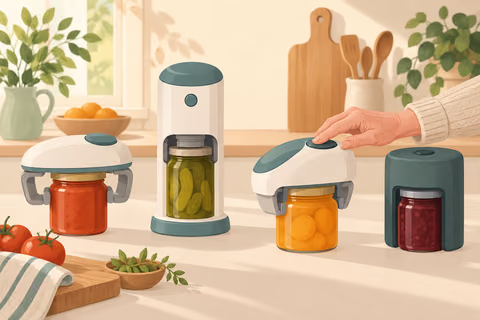
- Electric jar opener if twist remains. Catalog identities: Robo Twist Original (model
1014) and KITCHENMUH KC12. These are jar tools. A Kitchen Mama can opener is a different machine.
None of these steps treat arthritis. They change the mechanics of a lid.
Why the order matters
Each step removes one demand so the next step carries less of the load. Stabilizing the jar means the gripping hand stops fighting a moving object, so less pinch force is needed everywhere downstream. Breaking the vacuum — when the food maker permits it — removes most of the lid’s clamping force, which is why a formerly impossible jar sometimes opens with two fingers afterward. Friction and leverage tools then change the kind of grip required: a wide pad spreads pressure across the palm instead of concentrating it in fingertip pinch, and a mounted opener holds the lid so the hand does not pinch it, but the jar body still turns.
Going backward — gripping harder with bare hands on a slippery jar — is the pattern that exhausts the small joints fastest. It is also the pattern most likely to end in a dropped jar. If a step causes sharp pain, that is the step to stop at, not push through; the jar opener decision tree goes deeper into the mechanics, and the arthritis kitchen guide maps the tool families overall.
Choosing between the tool families
| Family | What it changes | Best when | Watch for |
|---|---|---|---|
| Non-slip pad (counter) | Grip surface, nothing else | Grip works but lids are slippery | Pad must be cleaned; small lids still need twist |
| Handheld pad opener | Grip width and pressure spread | Fingertip pinch is the painful part | Two hands still needed at counter level |
| Under-cabinet mounted | Lid grip and steadiness | Twist is possible but lid grip is not | Lift to mount; cabinet surface; V-grip fit |
| Electric jar opener | The twisting itself | Twist and grip both fail | Counter space; lid-size range per the maker |
Read the table as a decision path, not a ranking: the right family is the one that removes the specific demand that fails in your hands. The electric jar opener guide and the manual jar gripper comparison cover powered and non-powered options; the non-slip pad guide separates pad, base-pad and mounted families.
What this page will not do
- Count “9 of 10 test jars.” There was no such protocol here.
- Tell you to ignore a clinician.
- Mix can openers, bottle levers, and jar tools as one “5-in-1 winner.”
- Claim any tool reduces pain. Tools change mechanics; pain is a medical conversation.
If opening jars has become a daily wall rather than an occasional nuisance, that pattern itself is worth mentioning at the next appointment — occupational therapists work on exactly this and can match techniques to your hands.
Frequently asked questions
What should I try first if my hands hurt on lids?
Stabilize the jar so it cannot spin, then add friction or a documented opener. If pain is new, severe, or includes numbness, that is a clinical question — see NIAMS and your clinician, not a marketplace listing.
Does hot water always help?
No. It can help some metal lids and can be a bad idea on others. The food manufacturer’s packaging wins.
Will an electric opener open bottles and cans too?
Only if that model’s manual says so. Catalog jar openers above are not proof of can or crown-cap function.
Is there a tool that opens every jar?
No maker’s documentation supports “every jar” claims, and lid standards vary by brand and food type. Match the tool family to the jars actually in your kitchen, and check the maker’s stated lid-size range.
When is this a doctor question?
When pain is new, worsening, sharp, or comes with numbness or weakness, or when jars join a wider pattern of dropped objects. NIAMS and the CDC both frame arthritis management as a plan made with a clinician.
Sources
-
Granitestone: Robo Twist automatic jar opener Related reading: Jar opener decision tree · Manual jar gripper options · Electric jar openers · Non-slip pads · Arthritis kitchen guide
Models named in this guide
Catalog-verified identities, checked against the listing on the date shown. Prices and availability change; re-check the listing before buying.
- no photoOXO Good Grips Jar Opener with Non-Slip Base PadView the listing →
- no photoRobo Twist Original Electric Jar OpenerView the listing →
 KITCHENMUH Electric Jar OpenerView the listing →
 EZ Off Under-Cabinet Jar OpenerView the listing →