
Openers & grip
Under-Cabinet Jar Openers: Mount, Lift, Lid Range
On this page
How mounted openers workThe three checks before mountingHandheld and electric alternatives when the mount failsSkip conditions, stated plainlySourcesAn under-cabinet jar opener is the right tool only when two conditions hold: the cabinet can physically take the mount, and the person can lift the jar up to it. The opener removes the need to grip the lid, but it does nothing for the lift: the jar still has to be turned, a full pickle jar still weighs what it weighs, and it now has to travel from counter to cabinet height. If shoulders or grip cannot make that trip, a mounted opener is the wrong category, not the wrong brand. The Arthritis Foundation self-help devices page lists a fixed jar opener and rubber jar openers among practical aids; it does not describe drilling into someone else’s cabinets.
The research behind this page is entirely secondhand: manufacturer mount instructions, retailer listings and official health guidance, weighed against each other rather than against a row of openers bolted up in a workshop and scored. Because lid ranges and mounting hardware differ between listings, verify the current model and the seller’s return terms before you commit. Nothing here is medical advice.
Affiliate disclosure: As an Amazon Associate we earn from qualifying purchases. Direct
dplinks are catalog-verified identities only. Search links can mix variants. Check manufacturer, model, seller and price.
How mounted openers work
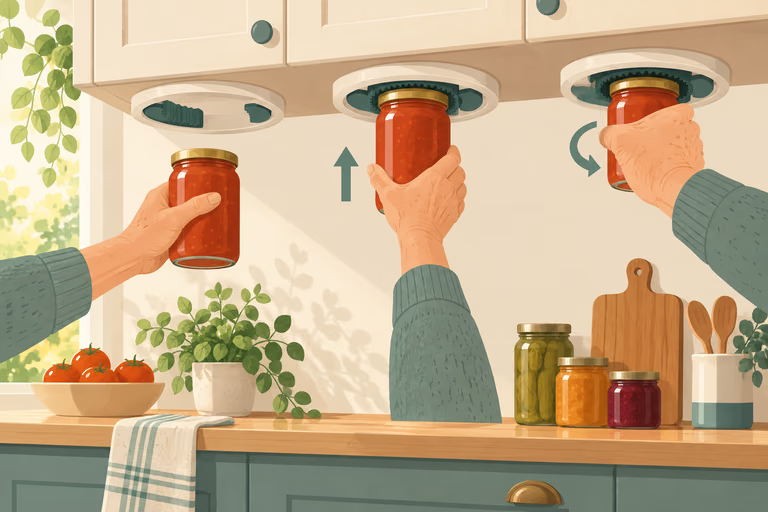
An under-cabinet opener is a toothed or textured V-grip screwed or glued to the underside of a cabinet. The jar’s lid slides into the V-grip, the person holds the jar body and turns, and the V-grip holds the lid while the cabinet takes the counter-force. The hand does not have to pinch the lid.
That design explains both its strength and its limits. The lid grip is eliminated; the jar body still turns. The jar must reach the V-grip, the lid must fit its opening, and the mount surface must support the force. A vise-style mounted opener in this catalog is the EZ Off under-cabinet model View Amazon listing.
The three checks before mounting
| Check | What to verify | Where to verify it | If it fails |
|---|---|---|---|
| Mount surface | Solid cabinet wood or frame, not thin particle-board or a rented shelf | Look under the cabinet; read the product’s mount instructions | Choose a handheld or countertop tool instead |
| Lift ability | The person can raise the heaviest jar they actually buy to cabinet height | Try it with a full jar and the current cabinet | Choose a counter-level or electric opener |
| V-grip fit | The V-grip accepts the lids actually used, from small sauce jars to wide pickle jars | Manufacturer’s mount instructions and the physical opening | Use a gripper pad or a different opener |
Adhesive-versus-screws is the first mounting decision. Follow the manufacturer’s mount instructions exactly; this site does not certify walls, cabinets, or adhesive in your kitchen. Renters should also check the lease or ask the landlord before drilling.
Handheld and electric alternatives when the mount fails
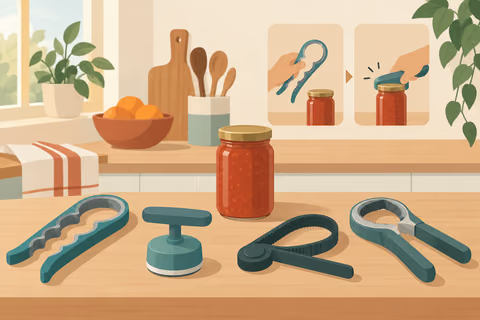
If the cabinet cannot take a mount, or the lift is the failing step, two other categories solve the same problem from a different direction. A handheld pad-style opener such as the OXO pad-opener View Amazon listing keeps everything at counter height — no lift required — but the hand supplies the twist again. An electric jar opener such as the catalog-verified unit View Amazon listing removes the twist while staying on the counter, trading mount effort for batteries and a footprint.
The honest decision rule: twist is the problem → electric. Lid grip is the problem but the jar can still turn → mounted or pad. Lift is the problem → countertop pad or electric. Both twist and grip fail → electric, placed at a comfortable counter height. The electric jar opener guide and the manual jar gripper comparison cover those categories in depth, and the opener spec table shows the manufacturer-documented EZ Off row alongside the other models.
Skip conditions, stated plainly
Skip the under-cabinet category entirely if the cabinets are particle-board that cannot hold screws, if the only “cabinet” is a freestanding shelf that will tip, or if a lease forbids drilling. Skip it too if lifting a full jar above shoulder height is already hard — the opener cannot help with that half of the task. For the wider set of opening tools and where each fits, the Complete Arthritis Kitchen Guide is the task map.
Frequently asked questions
Will it open bottles and cans too?
Only if that model’s own manual says so. The EZ Off identity in this catalog is a jar opener; treat multi-function claims in other listings as unverified until the manufacturer page confirms them.
Is adhesive strong enough, or do I need screws?
Follow the manufacturer mount instructions — some models support both, some specify one. Mount into solid cabinet material, not thin panel. This site does not certify drywall, particle-board, or any adhesive in a specific kitchen.
What if the jar is too heavy to lift?
Then the mount is the wrong answer regardless of brand. Choose a counter-level tool: a handheld pad opener or an electric opener keeps the jar where it already is. The failing motion, not the brand, decides the category.
Can I mount it under a shelf instead?
Only a surface that can take the mount force safely. A freestanding shelf that pulls or tips under downward force is a hazard. If nothing in the kitchen qualifies, use a non-mounted opener.
Sources
-
Zulay Kitchen: EZ Off under-cabinet jar opener Related reading: Opener spec table · Manual grippers · Complete Arthritis Kitchen Guide
Models named in this guide
Catalog-verified identities, checked against the listing on the date shown. Prices and availability change; re-check the listing before buying.
 EZ Off Under-Cabinet Jar OpenerView the listing →
- no photoOXO Good Grips Jar Opener with Non-Slip Base PadView the listing →
- no photoRobo Twist Original Electric Jar OpenerView the listing →
More guides for this task
Openers & grip
How to Choose a Jar Opener: Task, Then Model
Openers & grip
How to Open Jars With Arthritic Hands: A Safe Order
Openers & grip
How to Set Up an Arthritis-Friendlier Kitchen