
Openers & grip
How to Set Up an Arthritis-Friendlier Kitchen
On this page
The principle: cut the motions, not the cookFour stations to set upWhat to move this weekend: a short work listTools that earn their drawer spaceSourcesA friendlier kitchen is fewer extra motions: the opener lives next to the jars, the board does not walk, the kettle’s filled weight is acceptable, the path is lit. The Arthritis Foundation self-help devices page lists jar openers, reachers and built-up handles; tip #9 on its joint-protection page says to use the largest, strongest joints and slide objects rather than lift. CDC arthritis basics support staying active in daily tasks; they do not design your cabinets. This page turns those ideas into a walk-through of the kitchen itself.
Disclosure: This page has no affiliate links. The buying guides it links to contain Amazon affiliate links; we may earn a commission if you buy through them, at no extra cost to you.
The principle: cut the motions, not the cook
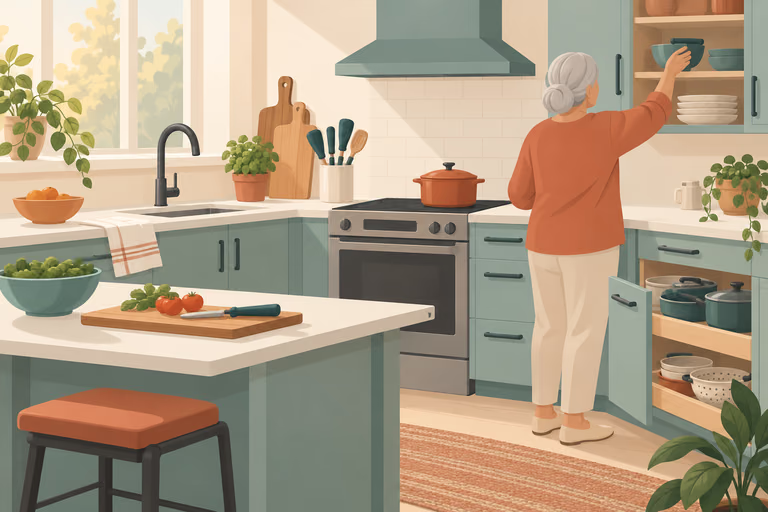
The Arthritis Foundation’s self-help devices page points in the same direction: built-up handles and reachers reduce grip demand, and tip #9 on its joint-protection page favors large joints and sliding over lifting. None of that requires a renovation. Most kitchens improve with rearrangement, not construction:
- The tool you use twice a day should live within one arm’s reach of where you use it.
- Anything requiring a twist, a pinch, or a hard press gets a tool substitute or a different position.
- Heavy things move to waist height; a step stool is a fall risk with stiff hands.
For clinical questions about what a specific person’s hands can safely do, an occupational therapist owns that advice. The layout below is general planning, not therapy.
Four stations to set up
- Opening station: one drawer or hook with the actual lid tools from the jar opener decision tree. A tool in the garage is unused. Include the jar gripper, the under-cabinet opener if the cabinet can take the load, and the bottle key.
- Prep station: a board with feet or a documented one-handed system (boards); a rocker knife only if a sharp edge is appropriate. A damp towel under the board is the cheapest stabilizer in the kitchen.
- Hot-water station: kettle capacity vs filled weight (kettles); cord and base where it cannot be yanked. The filled kettle matters more than the empty one on the box.
- Path lighting: for the everyday night path, use a dusk-to-dawn night light. The auto-on outlet unit is a power-failure light, not an everyday night light; keep a battery lantern for outages (USFA). The light must be on the route actually walked, not the route you wish were walked.
Mats: bevel vs trip is a fall question (arthritis kitchen guide). A clinician owns gait advice.
What to move this weekend: a short work list
| Station | Common problem | First fix, no purchase needed |
|---|---|---|
| Opening | Opener lives in a gadget box across the room | Move it into the drawer beside the jars |
| Prep | Board slides while cutting | Damp towel underneath; feet-up board if that fails |
| Hot water | Kettle overfilled, cord crosses the walkway | Mark the fill line with tape; reroute the cord along the wall |
| Lighting | Dark hallway to the bathroom at night | Move a lamp or night light onto that route; power-failure light only for outages |
| Heavy items | Stand mixer or dutch oven on a high shelf | Move to the counter or waist-height shelf |
Every row above costs minutes, not money. Do those first; buy tools only for the problems that remain.
Tools that earn their drawer space
After the layout pass, a few tool categories consistently pay rent in a stiff-handed kitchen:
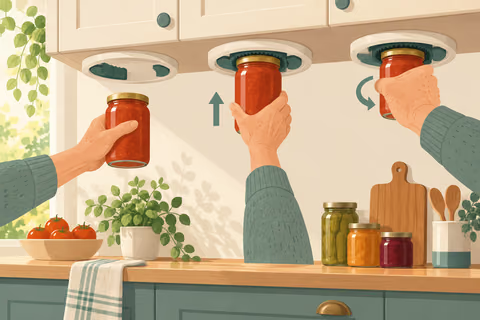
- Jar and lid tools. A gripper pad and, where cabinets allow, a mounted under-cabinet opener such as the EZ Off spec row — mounted only on a cabinet that can take the load and at a height where the user can lift a jar to it.
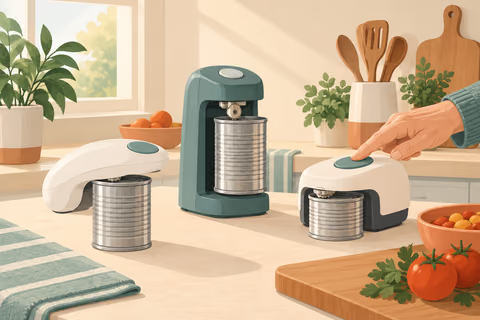
- Electric assistance for repeated twisting. Where cans happen daily, an electric can opener removes the twisting motion; the one-touch can opener guide frames that choice. Bottle caps use a different tool: see the bottle opener guide.
- Light cookware with two handles. Weight at the stove is a wrist question; the two-handle pot options exist for that reason.
- One control surface per appliance. A kettle with one switch beats a panel of buttons; the automatic shutoff kettle guide covers that trade.
The arthritis kitchen guide is the full catalog by task if you want to go beyond the starter set above.
Frequently asked questions
Do I need to remodel?
Usually no. Relocating the four stations beats a renovation SKU, and the work-list table above is free.
Where do I put a mounted jar opener?
Only on a cabinet that can take the load and that the user can lift a jar to. The EZ Off row in the spec table shows the manufacturer source.
How long does a setup like this take?
The rearrangement pass in the table is an afternoon. Tool purchases are optional follow-ups once you see which problems the layout alone did not solve.
Who should I ask about what my hands can safely do?
An occupational therapist or the clinician managing the arthritis. Guides like this one, and the Arthritis Foundation’s self-help devices page, are general education — not an assessment of a specific person.
Sources
- Arthritis Foundation: self-help arthritis devices
- CDC: Arthritis basics
- USFA: Candle fire prevention
Related reading: Arthritis kitchen aids task map · Kitchen gifts by task
More guides for this task
Openers & grip
Under-Cabinet Jar Openers: Mount, Lift, Lid Range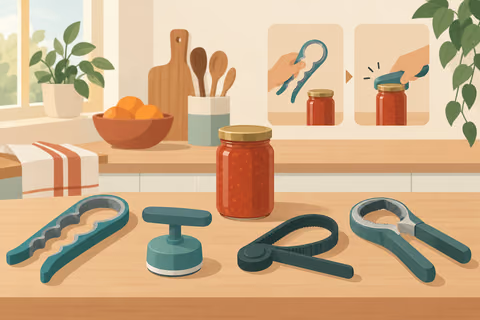
Openers & grip
How to Choose a Jar Opener: Task, Then Model