
Outage essentials
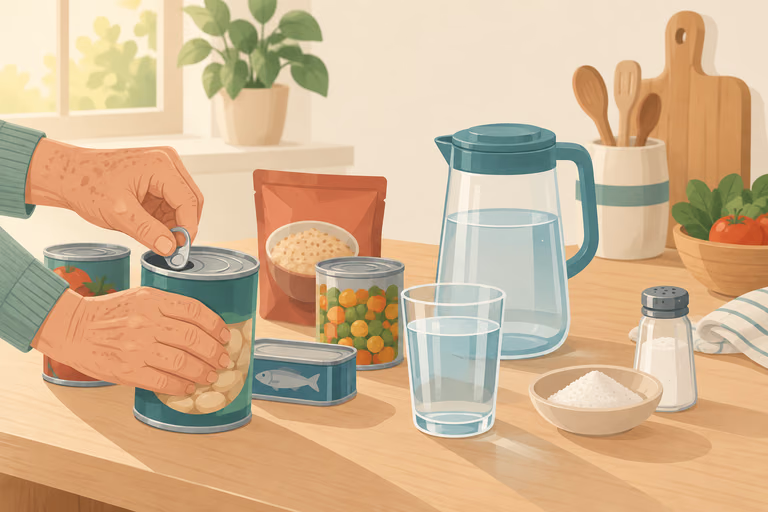
No-Cook Emergency Food: Opening, Water, Sodium
On this page
What “no-cook” really has to meanThe main categories, comparedWater is part of the food planOpening, chewing, and diet limitsSourcesNo-cook emergency food is only useful if the person can actually open the package, has water to go with it, and can eat it within the limits of their diet. A shelf-stable meal that needs boiling water is not a no-cook plan. A kit that ignores a low-sodium diet is not a plan either. Ready.gov’s kit guidance includes food and water in a basic emergency kit; it does not rank products. Fridge and freezer clocks during an outage follow FoodSafety.gov’s outage chart.
Nothing in this guide was tasted, opened, or stocked in a pantry trial; it is assembled from published retailer and public-safety information. Before an outage, verify what is actually in each package or can on the current listing and check the seller’s return terms. This is shopping research, not medical or dietary advice.
Affiliate disclosure: As an Amazon Associate we earn from qualifying purchases. Direct
dplinks are catalog-verified identities only. Search links can mix variants. Check manufacturer, model, seller and price.
What “no-cook” really has to mean
A true no-cook item meets three tests at once. First, it opens with the hands and tools the household already has — tear notch, pull tab, or ordinary kitchen scissors. Second, it is eaten as-is or with water that is already stored or boiled safely on a different day. Third, the sodium, sugar and allergens fit the person’s actual diet.
Most “emergency food” marketing answers none of these questions. Kit titles talk about servings and shelf life. The practical checks are on the package itself: how it opens, what it needs, and what is in it. Read those before reading anything else.
The main categories, compared
Freeze-dried pouch meals (add hot water; not no-cook), ready-to-eat bars, canned goods, and ordinary pantry food each solve a different slice of the problem. The table below compares them on the checks that matter to an older adult eating through a multi-day outage.
| Category | How it opens | Water needed | Watch for | Best use |
|---|---|---|---|---|
| Freeze-dried pouch meals | Tear notch or scissors | Hot water, usually | Needs a safe heat plan; not truly no-cook | Only when a safe heat source is already planned |
| Ready-to-eat bars | Wrapper, often a tear notch | Little or none | Dense, sweet; not a full diet for days | Grab-and-go, first hours of an outage |
| Canned beans, fish, fruit | Pull tab if lucky; otherwise a can opener | None | Needs a working can opener; check sodium | Multi-day shelf-stable protein and fruit |
| Ordinary pantry food | Varies | Varies | Rotates fast if it is also everyday food | Cheapest option for people who already stock it |
Search ready-to-eat bars on Amazon. Pouch meals and 72-hour kits are a different category: they need a safe heat plan, and a kit box is a manufacturer claim, not an official standard. Read the label for what is actually inside. A “72-hour” serving chart on a kit box is a manufacturer claim, not an official standard. Read the label for what is actually inside.
Water is part of the food plan
Freeze-dried pouch meals need water, usually hot. That turns them into a water-and-heat problem, not a no-cook plan. Ready.gov’s water guidance is the place to start for how much to store. If a pouch needs boiling, the heat source has to be safe for the dwelling — never a charcoal grill or camp stove indoors, which is a carbon-monoxide risk (Ready.gov power-outage guidance).
If boiling is not realistic, skip pouch meals entirely and build the kit from bars, cans and pantry food that need no heat. It is a plainer menu, but it works on the worst day.
Opening, chewing, and diet limits
Three practical checks decide whether stored food gets eaten:
- Opening. Does every item open with the tools in the drawer? If not, add kitchen scissors to the kit and practice the tear notch once, before an outage.
- Chewing and swallowing. Dense bars are hard work for some older adults. If chewing is already a clinical issue, the diet question belongs to the clinician, not a marketplace listing.
- Diet limits. Sodium, sugar and allergens are on the label. Emergency kits are not exempt from a low-sodium or diabetic diet. Read the panel the same way as everyday groceries.
The power-outage readiness hub shows where food fits in a full outage plan. For the water layer, see easy-open water storage; for light, see easy flashlights for elderly hands.
Frequently asked questions
Do I need to boil Mountain House pouches?
Read that pouch. Many freeze-dried pouch meals need hot water to rehydrate, which means a safe kettle or heat plan — not indoor charcoal. If there is no safe way to boil water in this home, choose foods that need none.
Is a candy bar a good emergency food?
Calories alone are not a kit. A candy bar brings no water, no protein, no meds and no opening plan. It is a morale item, not an emergency meal.
How much food should a senior store?
Ready.gov’s kit guidance suggests several days of food and water per person. The exact amount depends on the household, storage space and any clinical diet. Start with three days of food that needs no cooking and no refrigeration.
Are emergency food bars safe for diabetics?
That is a clinician question. Most bars are dense in sugar and refined carbohydrates. A person with diabetes should ask their care team what belongs in an outage kit, then read labels to match the answer.
Sources
Related reading: Power-outage readiness hub · Easy-open water storage · Easy flashlights
More guides for this task
Outage essentials
Best Lightweight Lantern for Elderly Hands With Arthritis
Outage essentials
Winter Apartment Blackout: Light, Water, No Indoor Fuel
Outage essentials
Best Flashlight for Elderly: Easy Power-Outage Picks