Gifts & safety
How to Help an Elderly Parent Cook More Safely
On this page
Step 1: Ask what already failed, then fix thatStep 2: Fix paths and lighting before toolsStep 3: Choose tools that remove the failing motionWhat you cannot buy: backup power and clinical limitsSourcesAdult children usually arrive with gadgets, and gadgets are rarely what the kitchen needs first. The dominant risks in an older adult’s kitchen are unattended heat, heavy pours, and dark paths — and the official guidance is about behavior and environment before equipment. The U.S. Fire Administration’s cooking-fire page is about staying in the kitchen while cooking and keeping heat sources clear of anything that can burn. The Arthritis Foundation’s self-help devices page lists jar openers, reachers, electric can openers and built-up handles — examples of tool categories, not a prescription. Neither page replaces a clinician if swallowing, cognition, or gait has changed; those changes are medical conversations, not shopping.
Disclosure: This page has no affiliate links. The buying guides it links to contain Amazon affiliate links; we may earn a commission if you buy through them, at no extra cost to you.
The advice here is grounded in official fire-safety and self-help device guidance and in what retailers publish about their products — not in any hands-on trial, and no numeric ranking or volunteer scoring is offered. Whichever tool you land on, re-check its live listing, model, and return terms the day you order. Nothing here is medical advice.
Step 1: Ask what already failed, then fix that
The most effective caregiving question is “what happened in this kitchen in the last month?” — not “what should I buy?” Each past incident points at a specific fix:
| What already failed | The risk | First fix | Where to verify |
|---|---|---|---|
| Burner left on | Fire | Turn the burner off if you leave the kitchen; USFA says stand by your pan. A timer is for oven dishes, not a burner substitute | USFA cooking-fire page |
| Kettle too heavy to pour | Burn, drop | Compare filled weight, not empty weight; auto-shut-off as backup, never a guarantee | lightweight kettle guide |
| Jars impossible to open | Grip strain, workaround injuries | A decision path matched to the failing motion | jar opener decision tree |
| Night snacks in the dark | Fall | A flashlight or plug-in light on the path — never a candle | USFA candle page |
USFA’s rule has no timer exception: stand by your pan, and turn the burner off if you leave the kitchen. A loud timer is useful for an oven dish or a simmer, but it does not make an unattended burner safe. If a timer is the chosen reminder for oven dishes, compare reach, button size, and loudness in the large-button kitchen timer guide. For an everyday night path, use a dusk-to-dawn night light; the auto-on plug-in unit is a power-failure light, not an everyday night light.
Step 2: Fix paths and lighting before tools
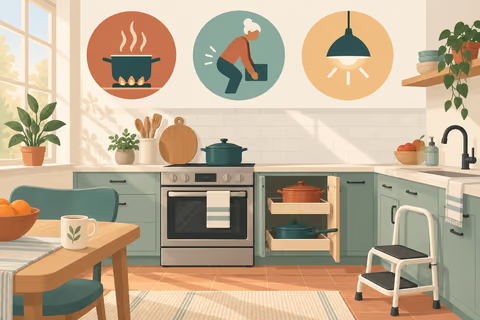
Falls and burns are both kitchen risks for older adults. Walk the route from refrigerator to sink to stove with the person, at night, and look for: rugs that slide, a dark hallway between bedroom and kitchen, cords crossing a walkway, and a step stool nobody should be climbing. Moving the most-used items to counter height removes the step-stool and the deep-bend reach at once. A non-slip mat at the sink helps only if it does not itself slide — check the backing. The broader room-by-room pass is in the senior kitchen safety checklist and the arthritis kitchen guide; the station-by-station layout is in how to set up an arthritis-friendlier kitchen.
Step 3: Choose tools that remove the failing motion
Match each tool to the motion that already failed, one tool per task. Opening: the jar opener decision tree maps jar, can, and bottle openers by grip type. Lifting and pouring: two-handle pots and lightweight pans, compared in the two-handle pot guide and lightweight cookware guide. Heating water: compare auto-shut-off kettles in the automatic shut-off kettle guide — with the explicit caveat that shut-off is a backup layer, not permission to walk away from a boiling kettle. For the whole task map, the Complete Arthritis Kitchen Guide is the parent page.
One anti-pattern to name plainly: do not gift a mixed “arthritis bundle” whose SKUs you would not buy one by one. Bundles pad with items the household will never use, and every unused item is a drawer that will not open and a decision the cook must ignore daily.
What you cannot buy: backup power and clinical limits
Some risks have no SKU. Backup power for oxygen concentrators or CPAP is a clinical and utility plan, arranged with the supplier and the power company before an outage — some utilities keep priority-restore lists for households on powered medical equipment; ask yours whether it does and what it covers. And any improvisation with indoor generators, charcoal grills, or camp stoves is a carbon monoxide event, not a workaround: Ready.gov’s power-outage page is explicit that fuel-burning equipment belongs outdoors, away from windows and vents. If swallowing, memory, or balance has changed, the right first call is the person’s clinician or an occupational therapist — who can also do a home safety assessment no blog can.
Frequently asked questions
Should I take over all cooking?
That is a family and clinical decision, not a product choice. Taking over removes practice and autonomy along with risk. If cognition, burns, or near-misses are already happening, gadgets are not the first intervention — the clinician is. Between those extremes, targeted fixes (timer, lighting, one opener) usually protect independence better than a takeover.
Is auto-shut-off enough to leave the kettle?
No. It is a backup against one failure mode, and shut-off mechanisms themselves fail. USFA’s advice does not have a gadget exception: do not leave active cooking or heating unattended.
Where do we start if nothing has “failed” yet?
Walk the kitchen at night and time a normal cook session. Unattended-heat habits, dark paths, and heavy pours show up before they cause an incident. Fix the night path and the burner-off habit first; add an oven timer only for oven dishes. These carry the least stigma and the most coverage.
Are gift bundles of arthritis kitchen tools a good idea?
Rarely as-is. Bundles are chosen by the giver, not matched to the failing motion. Buy the one tool for the one documented problem, and let the collection grow from real failures — that is also cheaper than replacing a bundle nobody uses.
Sources
- USFA: Cooking fire safety
- USFA: Candle fire prevention
- Arthritis Foundation: self-help arthritis devices
- Ready.gov: Power outages
- NIAMS: living with arthritis
Related reading: Jar opener decision tree · Automatic shut-off kettles · Complete Arthritis Kitchen Guide