Gifts & safety
Senior Kitchen Safety Checklist: Heat, Lifts, Light
On this page
Checklist (tick with the person, not for them)Why heat leads the listHow to use this checklist without insulting anyoneSourcesDisclosure: This page has no affiliate links. The buying guides it links to contain Amazon affiliate links; we may earn a commission if you buy through them, at no extra cost to you.
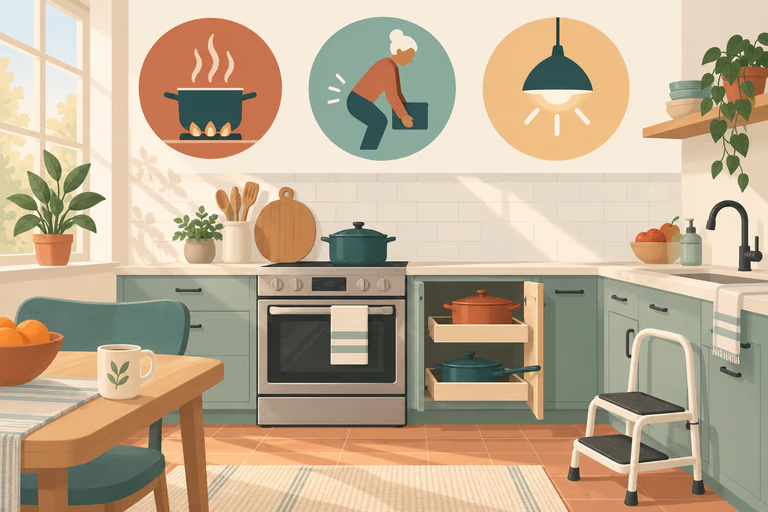
Many preventable kitchen injuries trace to a small set of repeatable situations: heat left alone, heavy or awkward lifts, and moving in the dark — not a missing branded gadget. Public safety guidance addresses the first and third directly: the U.S. Fire Administration cooking-fire page sets the heat rule — stay with cooking and keep combustibles clear — and the USFA candle guidance says to prefer a flashlight over candles in an outage. The middle problem, lifts, is a task-fit question that product pages and an occupational therapist can both inform. This checklist walks those three hazards in order, ticked with the person, not for them. It is a research checklist built from published safety guidance, not a tested product ranking, and it is not medical advice.
Checklist (tick with the person, not for them)
- Unattended heat. Who stays in the kitchen when a burner or oven is on? USFA’s rule is presence: cooking does not run itself safely. If the person dozes, leaves the room, or loses track of time, that is the first conversation — before any product discussion.
- A timer for oven dishes. USFA’s rule is to stand by your pan and turn the burner off if you leave the kitchen; a timer does not make an unattended burner safe. For oven dishes or a simmer, a loud, large-button timer helps. The published large-button timer guide names the ThermoWorks Extra Big & Loud; verify digit size, volume and power source on the listing.
- Kettle shut-off and weight. Does the kettle’s manual document auto-shut-off and boil-dry protection, and is the filled weight acceptable for the person’s lift? A shut-off is a backup if you are delayed — not permission to leave the room. See automatic shut-off kettle options.
- The usual pot. Can they lift it the way they actually cook — full, hot, from the back burner? Two-handle versus one-handle is a lift question, not a style preference; see two-handle pots and the lightweight cookware guide.
- The night path. From bed or couch to kettle or fridge: is it lit? For the everyday night path, use a dusk-to-dawn night light. The auto-on outlet light is a power-failure light, not an everyday night light; a battery lantern is for outages. Never a candle — USFA’s outage guidance prefers battery light.
- Knives. Cutting aids only if control is reliable. See the ergonomic knives guide for rocker-knife options, and the oven mitts guide for hot-pan handling. If grip or steadiness is failing, that is a clinician conversation before it is a knife purchase.
- No indoor combustion. No generator, charcoal grill, or camp stove indoors, ever — carbon monoxide kills quietly. Ready.gov’s CO guidance covers placement and alarms.
- Outage light plan. Where do the lantern and flashlights live, and are the batteries fresh? A dark kitchen during an outage is when the previous six checks get tested at once.
Some questions are simply not checklist territory: gait, swallowing, cognition, and fall risk while reaching are clinician and occupational-therapy assessments. A checklist can surface the question; it cannot answer it. The arthritis kitchen guide covers the task map this checklist treats only in passing.
Why heat leads the list
Cooking is a leading cause of home fires, and USFA points to unattended cooking and combustible items near the burner. The checklist order reflects the risk order:
- Presence beats gadgets. No shut-off device replaces a person in the room. Products documented as auto shut-off are the second line, not the first.
- Clear the zone. Combustibles — paper towels, packaging, curtains — move before the burner lights, not after.
- Wear the right sleeves. Tight or short sleeves near a flame; loose fabrics catch.
- A timer is for oven dishes, not burners. It can remind you about an oven dish or a simmer; it does not make an unattended burner safe.
The wider caregiver walkthrough — heat, lighting, lifts and the failing motion — is in how to help a parent cook safely. The Complete Arthritis Kitchen Guide maps every tool category mentioned above by task.
How to use this checklist without insulting anyone
A safety walk-through fails if it becomes a lecture. Three practices keep it collaborative:
- Tick together. The person walks their own kitchen and answers; you write. Ownership of the answers keeps changes alive after you leave.
- One change at a time. “Move the paper towels” this week; “try a louder timer” next. Five simultaneous changes guarantee none survive.
- Separate shopping from safety. First fix what costs nothing (clearance, habits, placement). Products — kettles, timers, lights — come after, chosen for the specific gap the walkthrough revealed. When you do shop, verify the model and manual on the listing, the same way every guide on this site recommends.
Frequently asked questions
Does auto-shut-off mean I can start the kettle and sit down in another room?
No. USFA still says not to leave cooking unattended. Shut-off is a backup for the moment you are delayed, not a substitute for presence. Treat it as the safety net, never the plan.
Are anti-fatigue mats safety devices?
No. They are standing-comfort products, and their raised edges create a trip hazard at exactly the height feet catch. If standing comfort matters, weigh that against the edge; see the arthritis kitchen guide.
What is the single highest-value change?
Whatever the walkthrough exposed first, which is usually presence during cooking. A person who stays in the kitchen while anything is on removes the top risk before buying anything.
Should timers, kettles, and lights be bought as a bundle?
No. Buy for the specific gap each check exposed, one item at a time, with the model verified on its listing. Bundles mix unrelated products and hide the identity checks this site keeps repeating.
Who decides if my parent can safely keep cooking?
A clinician or occupational therapist — especially for gait, reach, cognition, and swallowing. This checklist organizes the conversation; it does not replace the professional judgment.
Sources
Related reading: Help a parent cook · Automatic shut-off kettles · Complete Arthritis Kitchen Guide
More guides for this task
Gifts & safety
Thanksgiving Cooking With Arthritis: Heat, Lids, Knives
Gifts & safety
How to Help an Elderly Parent Cook More Safely